
Navigating the complexities of Medicare can often feel like deciphering a cryptic code, especially when it comes to understanding and managing your monthly premiums. As we look ahead to 2026, many beneficiaries are already contemplating how to effectively manage their healthcare costs. Among the various components, Medicare Part B premiums stand out as a significant monthly expense for millions of Americans. The good news is that with strategic planning and a clear understanding of the rules, there are insider strategies that could potentially help you reduce your Medicare Part B premiums by up to 10% or even more. This comprehensive guide will delve deep into these strategies, offering practical solutions and actionable advice to help you keep more money in your pocket while ensuring you maintain essential healthcare coverage.
Anúncios
Understanding your Medicare Part B premiums is the first step towards managing them. These premiums cover your outpatient care, including doctor visits, preventive services, and some medical equipment. While a standard premium is set annually, many factors can influence what you actually pay, most notably your income. This guide will meticulously break down these factors and reveal how you can proactively address them to your advantage.
The Core of Medicare Part B Premiums: What You Need to Know for 2026
Before we explore reduction strategies, it’s crucial to grasp the fundamental structure of Medicare Part B premiums. Each year, the Centers for Medicare & Medicaid Services (CMS) announces the standard premium amount. However, this standard rate is only applicable to a portion of beneficiaries. A significant number of individuals pay more due to the Income-Related Monthly Adjustment Amount (IRMAA).
What is IRMAA and How Does It Impact Your Medicare Part B Premiums?
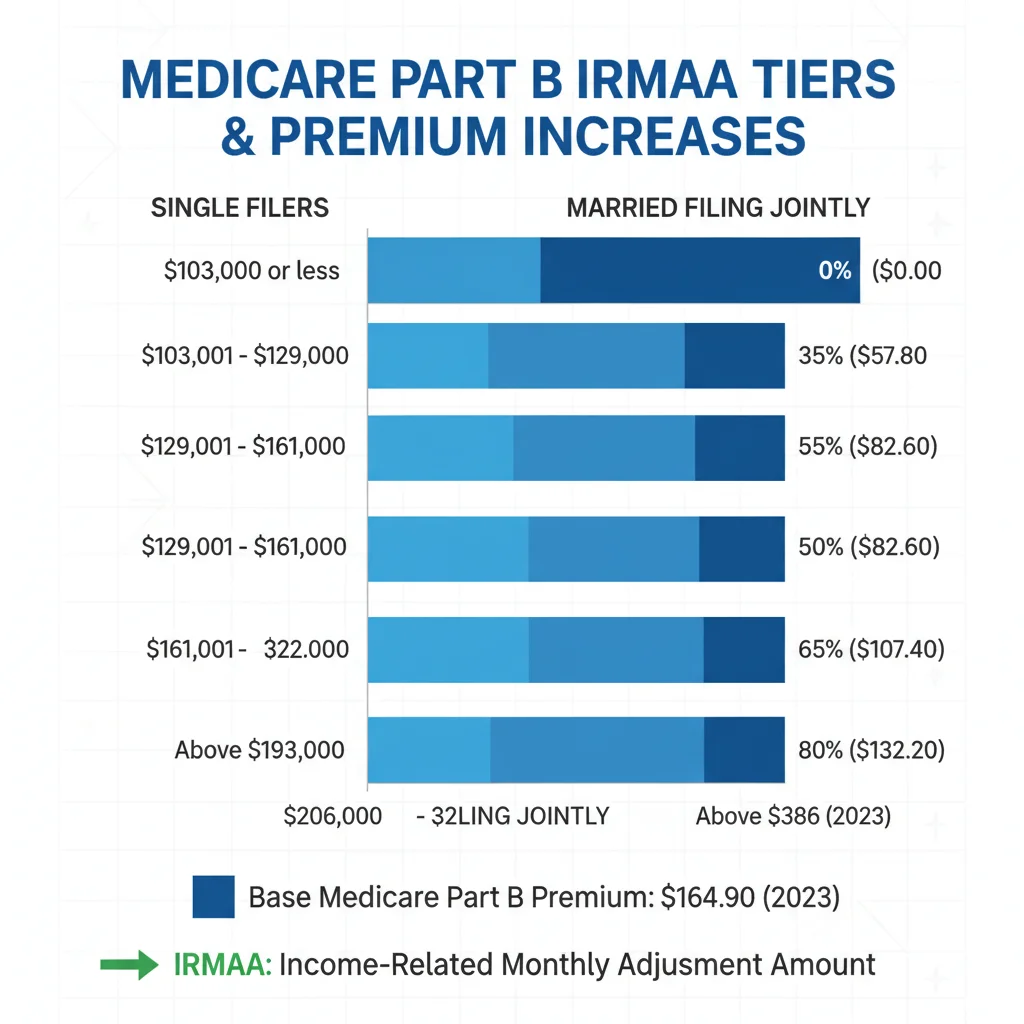
IRMAA is a surcharge added to your Medicare Part B (and Part D) premiums if your modified adjusted gross income (MAGI) exceeds certain thresholds. These thresholds are determined annually, typically two years prior to the benefit year. For example, your 2026 Medicare Part B premiums will likely be based on your 2024 tax return. This two-year look-back period is critical for planning, as it gives you a window to potentially adjust your income to avoid or reduce IRMAA.
Anúncios
The income brackets for IRMAA are progressive, meaning the higher your income, the higher your surcharge. It’s not just about being above a certain income level; it’s about which bracket you fall into. Each bracket has a specific percentage increase applied to your standard Part B premium. Understanding these tiers and where you currently stand, or where you expect to stand based on your 2024 income, is paramount.
For instance, if your MAGI in 2024 pushed you into a higher IRMAA bracket, you would face a higher Medicare Part B premium in 2026. Conversely, if you can strategically manage your income in 2024, you might be able to stay in a lower bracket or even avoid IRMAA altogether. This is where proactive financial planning becomes your most powerful tool.
Insider Strategy 1: Proactive Income Management to Reduce Medicare Part B Premiums
Since IRMAA is based on your income from two years prior, you have a unique opportunity to influence your future premiums. This strategy involves carefully managing your MAGI in the base year (e.g., 2024 for 2026 premiums). This isn’t about tax evasion; it’s about smart financial planning within legal and ethical boundaries.
Key Income Components Affecting IRMAA
Your MAGI for IRMAA purposes typically includes your adjusted gross income (AGI) plus tax-exempt interest income. This means that certain types of income, even if not taxed, can still push you into a higher IRMAA bracket. Common income sources that contribute to MAGI include:
- Wages and salaries
- Social Security benefits (a portion may be taxable)
- Interest (taxable and tax-exempt)
- Dividends
- Capital gains
- Pension and annuity income
- Traditional IRA and 401(k) distributions
- Rental income
Actionable Steps for Income Reduction
Here are some strategies to consider for reducing your MAGI in the base year:
- Roth Conversions (Strategic Timing): While Roth conversions are taxable events, strategically timing them can be beneficial. If you anticipate a year with lower income (e.g., prior to claiming Social Security or taking RMDs), converting a portion of your traditional IRA to a Roth IRA in that year might be advantageous. This pulls the tax hit forward into a year where it might have less impact on your IRMAA, and future Roth distributions are tax-free, thus not impacting future IRMAA calculations.
- Delaying Social Security Benefits: If you are still working and have substantial income, delaying Social Security benefits until your full retirement age or even age 70 can reduce your current MAGI. The delayed credits will also provide a higher monthly benefit later.
- Tax-Loss Harvesting: If you have investments, consider selling investments at a loss to offset capital gains and even a limited amount of ordinary income. This can reduce your overall taxable income and thus your MAGI.
- Qualified Charitable Distributions (QCDs): If you are age 70½ or older and have a traditional IRA, you can make a QCD directly from your IRA to a qualified charity. These distributions count towards your Required Minimum Distributions (RMDs) but are not included in your MAGI, effectively lowering your taxable income. This is a powerful tool for those who are charitably inclined and subject to RMDs.
- Managing Capital Gains: Be mindful of large capital gains from selling investments or property. If possible, spread out sales over multiple years or consider strategies like installment sales if applicable to avoid a single large income spike.
- Reviewing Retirement Account Withdrawals: If you are drawing from retirement accounts, strategize your withdrawal amounts. Consider a mix of taxable (traditional IRA/401k) and non-taxable (Roth IRA) withdrawals to keep your MAGI below IRMAA thresholds.
Insider Strategy 2: Appealing an IRMAA Decision
Even with careful planning, sometimes life throws a curveball. Significant life-changing events can drastically alter your income, making the two-year look-back period unfair. Fortunately, you have the right to appeal an IRMAA decision if you’ve experienced certain qualifying life events that caused a significant reduction in your income. This could potentially reduce your Medicare Part B premiums for the current year.
Qualifying Life-Changing Events
The Social Security Administration (SSA) allows for appeals based on specific life-changing events. These typically include:
- Marriage: If you were single in the base year and are now married, and your combined income places you in a lower IRMAA bracket.
- Divorce or Annulment: If your divorce or annulment significantly reduced your individual income.
- Death of a Spouse: If your spouse passed away, and your individual income is now much lower.
- Work Stoppage or Reduction: If you stopped working or reduced your work hours due to retirement, layoff, or other reasons, leading to a substantial decrease in earned income.
- Loss of Income-Producing Property: Such as selling a business or rental property that was a significant source of income.
- Loss of Pension Income: If you lost a pension or experienced a reduction in pension benefits.
- Settlement from an Employer: A one-time settlement that significantly inflated your income in the base year.
The IRMAA Appeal Process (Form SSA-44)
If you believe you qualify for an appeal, you’ll need to complete SSA Form-44, ‘Medicare Income-Related Monthly Adjustment Amount – Life-Changing Event.’ This form allows you to report a significant reduction in your income due to one of the qualifying events. You’ll need to provide documentation to support your claim, such as:
- Tax returns for the base year and the current year (or projected current year income).
- Letters from employers confirming work stoppage or reduction.
- Death certificates, divorce decrees, or marriage certificates.
- Documentation of loss of income-producing property or pension.
It’s crucial to submit this form and supporting documentation promptly. The SSA will review your case and make a determination. If approved, your Medicare Part B premiums will be adjusted for the current year based on your new, lower income. This can lead to a significant reduction, potentially reaching that 10% or more savings goal.
Insider Strategy 3: Exploring Medicare Savings Programs (MSPs)
For those with lower incomes and limited resources, Medicare Savings Programs (MSPs) offer a lifeline by helping to pay for Medicare Part B premiums, deductibles, coinsurance, and copayments. While these programs have strict income and asset limits, they are often overlooked and can provide substantial relief from healthcare costs.
Types of Medicare Savings Programs
There are four main types of MSPs:
- Qualified Medicare Beneficiary (QMB) Program: Helps pay for Part A and Part B premiums, deductibles, coinsurance, and copayments.
- Specified Low-Income Medicare Beneficiary (SLMB) Program: Helps pay for Part B premiums only.
- Qualifying Individual (QI) Program: Helps pay for Part B premiums only. (Funds are limited and provided on a first-come, first-served basis.)
- Qualified Disabled and Working Individuals (QDWI) Program: Helps pay for Part A premiums for certain disabled individuals who lost their premium-free Part A when they returned to work.
Eligibility Requirements for MSPs
Eligibility for MSPs is based on your income and resources (like bank accounts, stocks, and bonds), though certain assets like your home, one car, and personal belongings are usually not counted. The income and resource limits are updated annually and vary by state. It’s essential to check the most current guidelines for your specific state.
Even if you think your income might be slightly above the threshold, it’s worth investigating. Some states have higher limits, and certain types of income (like a portion of Social Security benefits) may be disregarded in the calculation. Applying for an MSP is done through your state’s Medicaid office.
Insider Strategy 4: Strategic Enrollment Decisions
Your enrollment choices can also impact your Medicare Part B premiums, particularly if you’re still working or have group health coverage through an employer.
Delaying Part B Enrollment
If you or your spouse are still working and have health coverage through that employer, you might be able to delay enrolling in Medicare Part B without penalty. This can save you from paying Part B premiums while you’re still covered by your employer plan. However, it’s crucial to understand the rules:
- The employer health plan must be considered “creditable coverage” by Medicare.
- The employer must have 20 or more employees (or 100 or more if it’s a multi-employer plan for disabled individuals).
Once your employment or employer coverage ends, you’ll have a Special Enrollment Period (SEP) to sign up for Part B without penalty. Missing this SEP can lead to late enrollment penalties, which are added to your Part B premium for as long as you have Part B.
Coordination of Benefits
Understand how your employer coverage coordinates with Medicare. In most cases, if you’re still working and have employer coverage, your employer plan pays first, and Medicare pays second. If you’re retired and have retiree health coverage, Medicare usually pays first. Knowing this helps you make informed decisions about when to enroll and how your benefits will be applied.
Insider Strategy 5: Annual Review of Your Financial Situation
Your financial situation is not static, and neither are Medicare’s rules. What worked one year might not be optimal the next. Therefore, an annual review of your income, assets, and healthcare needs is a critical, ongoing strategy.
Why an Annual Review is Essential
- Changing Income: Your income sources and amounts can change year to year (e.g., retirement, RMDs starting, investment gains/losses).
- Updated IRMAA Thresholds: The income thresholds for IRMAA are adjusted annually. What put you in a certain bracket one year might not the next.
- New Programs/Benefits: CMS occasionally introduces new programs or expands existing ones that could benefit you.
- Healthcare Needs: Your personal healthcare needs might change, influencing whether certain plans or strategies are more cost-effective.
What to Review Annually
- Tax Returns: Specifically, review your MAGI from two years prior to understand its impact on your upcoming Medicare Part B premiums.
- Investment Portfolios: Plan capital gains and losses strategically. Consider tax-efficient investment vehicles.
- Retirement Account Strategies: Evaluate your withdrawal strategy from traditional vs. Roth accounts. Consider QCDs if applicable.
- Social Security Statements: Understand your benefit amounts and any potential changes.
- Medicare Summary Notices (MSNs): Review these to ensure you’re not being charged for services you didn’t receive and to track your healthcare spending.
- State Medicaid/MSP Guidelines: Check for updated income and asset limits for Medicare Savings Programs in your state.

The Financial Impact: How Much Can You Really Save?
A 10% reduction in your Medicare Part B premiums might seem modest at first glance, but over a year, and especially over many years, it adds up significantly. For example, if the standard Part B premium in 2026 is, for illustrative purposes, $174.70 per month (the 2024 standard), a 10% reduction would save you $17.47 per month, or $209.64 per year. If you are subject to IRMAA, the savings could be even more substantial, as a reduction in your income bracket could lead to a much larger percentage decrease in your total premium.
Consider a scenario where careful income planning helps you avoid moving into the next IRMAA bracket. The difference between two IRMAA tiers can be hundreds of dollars annually. For instance, moving from one bracket to another could mean an additional $60 to $100 per month in premiums. Avoiding this jump through proactive planning translates directly into significant savings on your Medicare Part B premiums.
Furthermore, if you qualify for an MSP, the savings are even more dramatic, as the program could cover your entire Part B premium, representing a 100% reduction in that specific cost. The cumulative effect of these savings can free up valuable funds for other essential expenses, healthcare costs not covered by Medicare, or even leisure activities in retirement.
Common Pitfalls to Avoid When Managing Medicare Part B Premiums
While the strategies outlined above offer significant potential for savings, it’s equally important to be aware of common mistakes that could inadvertently increase your Medicare Part B premiums:
- Ignoring the Two-Year Look-Back: Failing to understand that IRMAA is based on income from two years prior is a major oversight. This means decisions you make today about income can impact your premiums in the future.
- Unplanned Income Spikes: Large, unexpected income events (e.g., selling a highly appreciated asset, cashing out a large retirement account, a significant bonus) without considering their IRMAA implications can lead to higher premiums.
- Not Understanding MAGI: Assuming only taxable income counts towards IRMAA. Remember that tax-exempt interest income is also included in the MAGI calculation for IRMAA purposes.
- Missing Appeal Deadlines: If you have a qualifying life-changing event, failing to submit Form SSA-44 in a timely manner can cause you to miss out on premium reductions.
- Not Reviewing Your Social Security Statements: The SSA sends out annual statements that can provide valuable information about your benefits and potential IRMAA implications.
- Delaying Part B Enrollment Without Creditable Coverage: If you don’t have creditable employer coverage after age 65, delaying Part B enrollment can result in lifelong late enrollment penalties.
- Not Seeking Professional Advice: Medicare and tax laws are complex. A financial advisor specializing in retirement planning or a Medicare counselor can provide personalized guidance and help you navigate these intricacies.
Conclusion: Empowering Yourself to Manage Medicare Part B Premiums in 2026
Navigating Medicare Part B premiums in 2026 doesn’t have to be a daunting task. By understanding the underlying rules, particularly those related to IRMAA, and by implementing proactive financial strategies, you can significantly influence your monthly costs. Whether it’s through strategic income management, appealing an IRMAA decision due to a life-changing event, exploring Medicare Savings Programs, or making smart enrollment choices, the power to potentially reduce your premiums by up to 10% or more is within your reach.
The key takeaway is to be proactive and informed. Don’t wait until you receive your annual premium notice to start thinking about these issues. Begin planning now, review your financial situation annually, and don’t hesitate to seek expert advice when needed. By taking these steps, you can ensure that your healthcare costs are manageable, allowing you to enjoy your retirement with greater financial peace of mind. Your health and your financial well-being are too important to leave to chance. Take control of your Medicare Part B premiums today and secure a more affordable healthcare future.